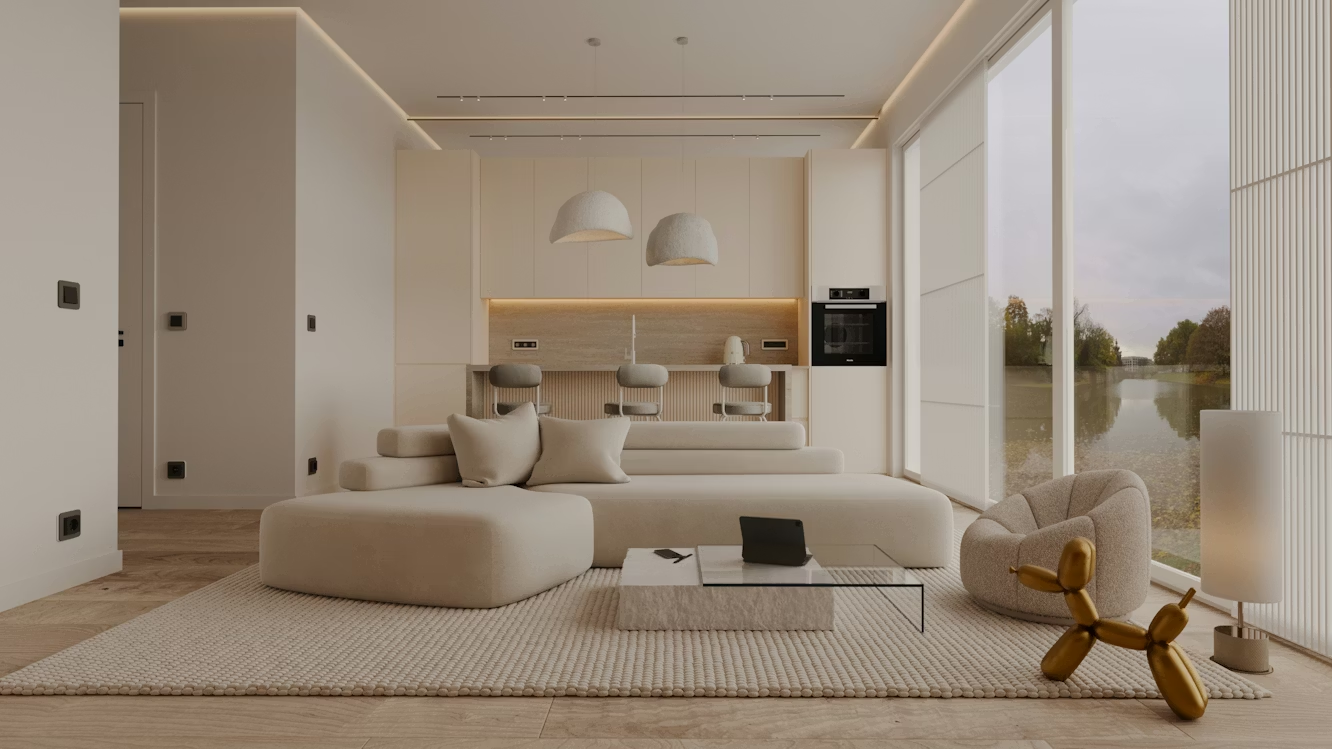
A handcrafted upholstered furniture brand out of the Northeast spent years relying on photography. Consistent, professional — and increasingly frustrating. Every shoot used the same backdrop. Roomsets were too expensive to consider. And each season, the cycle started again: new pieces, new bookings, new delays.
After switching to CGI, their workflow changed completely. Visual content could now be produced from technical drawings before a piece had even left the workshop. Adding a new colorway meant updating a file, not scheduling a studio. The same sofa could appear in a Tribeca loft, a Hamptons beach house, a Connecticut estate — all from one 3D model.
That kind of shift is happening across the furniture industry right now. CGI has moved from a production workaround to a genuine creative tool, and the brands working with discerning residential buyers are the ones pushing it furthest.
Still Images Were Never the Whole Story
For most of the last decade, CGI in furniture marketing meant still renders. And those renders got very good — photorealistic enough that interior designers and buyers couldn’t distinguish them from photography. That was useful. It meant a sofa could be shown in a Central Park West penthouse, a Montauk retreat, and a Brooklyn townhouse, all without leaving a studio.
But a static image, no matter how precise, can’t answer the question every serious buyer eventually asks: how does this actually move?
That question matters more than people realize. For reclining chairs, sectional configurations, extendable dining tables, and modular shelving systems, the mechanism is part of the value proposition. A buyer considering a $14,000 recliner wants to understand the motion — how the footrest deploys, how the back reclines, how the whole piece transforms. A photograph gives them nothing. A video of an in-store demo gives them a poorly lit clip shot on someone’s phone.
This is where dedicated 3D product animation services have stepped into a genuine gap in the market.
SUBSCRIBE TO THE HAVEN MAILING LIST
Curated homes, market intelligence and design stories — a few emails a month.
No spam. Unsubscribe any time.
What 3D Animation Actually Shows That Photography Cannot
The most immediate advantage is motion — but it goes further than showing a drawer sliding open. A well-produced animation can:
- Reveal internal construction — joinery methods, spring systems, upholstery layers — without destroying a sample piece
- Demonstrate modular configurations across an entire product family in a single sequence
- Show material behavior — how a fabric drapes, how a leather cushion responds to weight
- Walk a viewer through finishing details that photography compresses or loses entirely
For luxury brands whose entire value proposition rests on craft and precision, that last point matters most. The hand-applied lacquer on a cabinet door. The subtle variation in a hand-knotted textile. The way a drawer closes with hydraulic resistance. These are selling points that never survived the translation to product photography. Animation, handled correctly, can make them the centerpiece.
Assembly and Technical Animation: The Underrated Application
Beyond marketing, there’s a second category of 3D animation that’s gaining traction in the luxury segment: assembly and technical visualization.
High-end furniture often involves real complexity — custom configurations, on-site installation, pieces that arrive in multiple components. In a city like New York, where elevator dimensions, service entrances, and co-op building rules add friction to every delivery, the traditional reliance on in-person white-glove teams becomes expensive and hard to scale. Instruction manuals, meanwhile, go unread.
The emerging alternative is purpose-built 3D animated assembly videos — precise, step-by-step animations that show exactly how a piece goes together, which components connect where, and in what sequence. For brands selling internationally or through third-party retailers, this kind of content reduces installation errors, warranty claims, and customer service overhead while actually improving the ownership experience.
Interior designers working with these brands have noticed something else: clients who watch a clear assembly animation arrive at installation day with realistic expectations and fewer surprises. That alone is worth something in a high-touch service environment.
How This Connects to Residential Development and Sales
For those working in high-end residential development and sales, CGI furniture animation introduces an interesting possibility that’s just beginning to be explored: furnishing pre-built or under-construction spaces with photorealistic animated walkthroughs.
The standard virtual tour shows rooms. An animated presentation can show rooms as they’ll actually be lived in — how the furniture fits the proportions of the space, how natural light moves across specific materials at different times of day, how a custom piece integrates with the architectural details of the unit.
In a market like New York — where buyers may be choosing between a Tribeca conversion and a new Upper East Side tower from an open house brochure — that kind of content is increasingly what separates a memorable presentation from a forgettable one. Furniture brands with a foothold in these properties gain visibility before a buyer ever sets foot in a showroom.
The overlap between high-end real estate marketing and luxury product animation is newer than either field. But the logic is straightforward: both are selling a vision of how a space will feel. The tools to express that vision have gotten considerably more sophisticated.
Choosing the Right Studio
Not all CGI studios approach high-end furniture with the same sensibility. The technical capacity to render photorealistic animation is relatively widespread. The ability to render it with the right aesthetic — the restraint, the attention to material behavior, the understanding of what discerning buyers actually respond to — is rarer.
Brands evaluating studios should ask specifically about experience with premium residential and furniture clients. Request to see animations that feature textiles, leather, and complex joinery, not just plastic consumer electronics. The difference in approach is usually visible within the first few seconds.
Turnaround timelines and revision processes also matter. A brand preparing for a major trade fair or a development launching pre-sales has specific windows. The best studios build their workflow around client timelines rather than their own production convenience.
A Shift That's Already Underway
A custom upholstered furniture company in the US made a similar move — rebuilding their entire visual library with CGI: 3D models, lifestyle renders, 360-degree views, and animation. After the new site launched, attention to their products increased noticeably. More importantly, their catalog now expands with each new collection at a fraction of the previous cost and timeline.
Across the luxury furniture segment, that pattern is repeating. The brands and developers who moved early have a head start on content that’s flexible, scalable, and — when done well — genuinely more expressive than what photography was ever able to deliver.
The question now isn’t whether 3D animation belongs in luxury product marketing. It’s how far behind you want to be when you finally decide to use it.