On a well-appointed equestrian property, the stable should feel intentional, quiet, and effortless to use. But in barns, “beautiful” can’t come at the expense of function. Horses live in these spaces every day, and small design missteps—stagnant air, damp floors, cramped stalls, noisy hardware—can quickly become health and behavior issues that ripple into daily care.
A world-class stable gets the fundamentals right first: clean airflow, secure footing, sensible circulation, and a layout that supports both horse comfort and caretaker efficiency. When those elements are handled well, the aesthetics land naturally.
Ventilation: The Invisible Feature That Defines the Barn
In elite horse racing, including events as high-profile as the Kentucky Derby, conversations often focus on training programs, conditioning, and jockey strategy, alongside factors like how the Kentucky Derby live odds are moving that reflect public expectations of performance. Bettors are tracking every signal they can, especially the horse’s health. However, many of those signals are shaped long before race day, starting in the stable itself.
If there’s one non-negotiable in stable design, whether its resident horses competitively race or not, it’s air. Barns collect dust, moisture, and ammonia from urine, and those irritants concentrate quickly when air exchange is limited. Over time, poor ventilation can contribute to chronic coughing and respiratory sensitivity—problems that aren’t always obvious until they’re persistent.
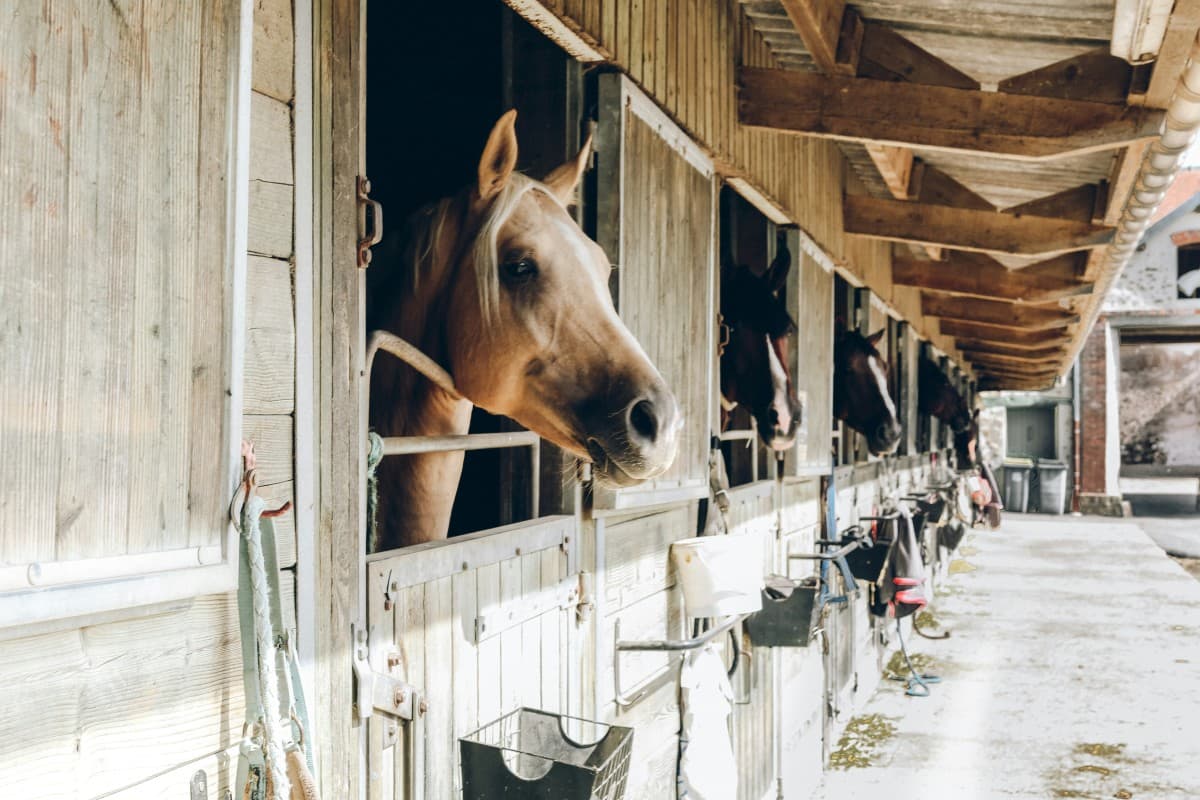
For luxury properties, the goal is to make the stable feel fresh without feeling drafty. The best solutions are architectural: higher ceilings that allow warm, stale air to rise; ridge vents that let it escape; open eaves; and windows or Dutch doors that can be adjusted seasonally. Done correctly, fresh air enters at horse level while warmer air exits above, keeping the environment cleaner and more comfortable without relying solely on mechanical systems.
Fans and mechanical ventilation can be useful support, but they work best as part of a barn that already “breathes.” In colder climates especially, blasting air directly onto horses can create new problems. A stable that’s designed for natural airflow tends to feel calmer, smell cleaner, and require less daily work to keep it that way.
SUBSCRIBE TO THE HAVEN MAILING LIST
Curated homes, market intelligence and design stories — a few emails a month.
No spam. Unsubscribe any time.
Footing: Where Luxury Meets Long-Term Practicality
In the home, materials matter because they’re touched, walked on, and lived with. In a stable, the floor matters for the same reason—only the stakes are higher. Flooring affects joints, hooves, traction, fatigue, and injury risk, and it’s one of the most expensive things to correct later.
Concrete alone is typically too hard. Dirt alone breaks down, holds moisture, and can become uneven. Rubber mats can add comfort, but only if what’s underneath is properly engineered.
A good stable floor usually combines a solid base with shock absorption and proper drainage. A slight slope is also very important, but you should focus on drainage first.
Moisture is the slow enemy of otherwise beautiful barns. It creates odor, softens footing, undermines materials, and can lead to slick conditions. A stable that stays dry not only protects horse health, it keeps the entire property feeling more refined: cleaner aisles, easier mucking, less lingering smell, and a noticeably better experience for anyone walking through.
Stall Size and Layout: Space That Reduces Stress
Luxury is often described as “space,” and horses feel that truth in a very literal way. Adequate stall dimensions allow a horse to turn, lie down, and rise comfortably—without feeling trapped. Too tight, and stress can show up as pacing, weaving, cribbing, or general agitation that’s sometimes mistaken for temperament.
But the stable layout matters just as much as size. Horses are social, and many do better when they can see their neighbors. Fully isolated stalls can increase anxiety, while designs that use half walls, bars, or open fronts often feel calmer and more connected—without sacrificing safety.
From an owner’s perspective, a world-class layout also supports effortless oversight. You shouldn’t need to step into every stall for a quick check. Clean sightlines, logical circulation, and a barn plan that minimizes backtracking make the day smoother for staff and far less disruptive for horses.
Light, Sound, and the “Feel” of a High-End Barn
The most memorable luxury spaces share an intangible quality: they feel good to be in. Stables are no different. Natural light helps support a healthy day-night rhythm and creates a brighter, more inviting environment for daily care. Dark barns lit only by harsh artificial light can feel flat and disorienting—especially if horses spend extended time indoors.
Sound is another overlooked factor that separates high-end barns from merely expensive ones. Echoing aisles, metal doors slamming, and clanging hardware create constant low-level stress. Quiet design choices—better door systems, softer latches, thoughtful materials, and reduced “tin” resonance—make the barn feel calmer and more controlled. If the stable is intended to be part of an estate lifestyle, it should feel serene, not industrial.
Humane Design: Comfort Through Choice
The best modern barns are built around a simple principle: give horses appropriate options whenever possible. Options to see other horses. Options to rest comfortably. Options to stand in fresh air. Options to move between stall and turnout in a predictable routine.
This doesn’t mean loosening standards or inviting chaos. It means designing a stable that works with horse behavior rather than fighting it. Wide aisles for safe handling, non-slip surfaces, straightforward access to turnout, and a plan that supports consistent routines all contribute to a sense of security. Horses thrive on predictability, and the built environment should reinforce that.
Final Thoughts
A world-class stable isn’t defined by a showpiece façade or decorative finishes. It’s defined by performance—air that stays clean, floors that stay dry, spaces that reduce stress, and a layout that makes daily care feel efficient and calm. For an equestrian property, that kind of design is both humane and smart: it protects the horses, supports the people caring for them, and elevates the entire estate experience.
Get the fundamentals right first. When you do, the stable’s beauty won’t feel imposed—it will feel inevitable.